

 In the welding industry, protective equipment for workers’ eyes and faces has evolved from passive defense to intelligent protection. Within the realm of auto-darkening welding helmets, a mysterious code—”1/1/1/1″—has become synonymous with top-tier optical performance. It not only represents the pinnacle of technology but also redefines safety and clarity standards in welding operations. TynoWeld has achieved mass-production breakthroughs in this standard through its proprietary patented technology, while advancements in core parameters like lightning-fast response speed and extreme environmental adaptability have propelled welding safety to unprecedented levels.
Four-Dimensional Optical Standard Analysis: The True Meaning of 1/1/1/1
According to the international optical standard EN 379, the “1/1/1/1″ rating of a welding helmet comprises four independent parameters, each “1″ signifying the highest performance in its respective dimension:
- First “1″: Optical Class
Refers to the lens’s distortion-free, blur-free imaging capability. Class 1 ensures no distortion at the center or edges of the field of view, akin to naked-eye observation, significantly reducing welding defects caused by visual errors. - Second “1″: Light Diffusion
Measures whether halos or ghosting occur when light passes through the lens. Class 1 means complete glare suppression, preventing welders from misjudging the molten pool due to visual interference. - Third “1″: Light Homogeneity
Reflects the consistency of shading performance across all areas of the lens. Class 1 guarantees no bright/dark patches in the field of view, preventing retinal damage from localized intense light penetration. - Fourth “1″: Angle Dependenc
Tests the stability of shading when the lens is tilted. Class 1 ensures that even with a 30° head tilt, the shade number variation remains below 0.5 levels, avoiding arc eye burns from lateral exposure.
Table: Welding Helmet Optical Rating Standards Comparison
| Parameter | Class 1 (Optimal) | Class 2 (Intermediate) | Class 3 (Basic) |
|---|---|---|---|
| Optical Class | Zero distortion, clear vision | Minor distortion, blurred edges | Significant distortion, impairs precision |
| Light Diffusion | No halos/ghosting | Slight glare | Severe ghosting, disrupts molten pool observation |
| Light Homogeneity | Perfectly uniform light distribution | Local brightness variation <15% | Visible uneven shading, unstable protection |
| Angle Dependence (30°) | Shade variation <0.5 levels | Shade variation <2.5 levels | Shade variation >2.5 levels, high risk |
Technical Implementation & Industry Breakthrough: Achieving 1/1/1/1
Traditional welding goggles often suffer from uneven shading due to viewing angle deviations (typically rated 1/1/1/2 or 1/1/1/3), with shade fluctuations exceeding 1 level at 15° tilt and plummeting by 2.5 levels at 30°, forcing frequent head adjustments. To achieve the extreme performance of 1/1/1/1, TynoWeld engineers have overcome three critical technical barriers:
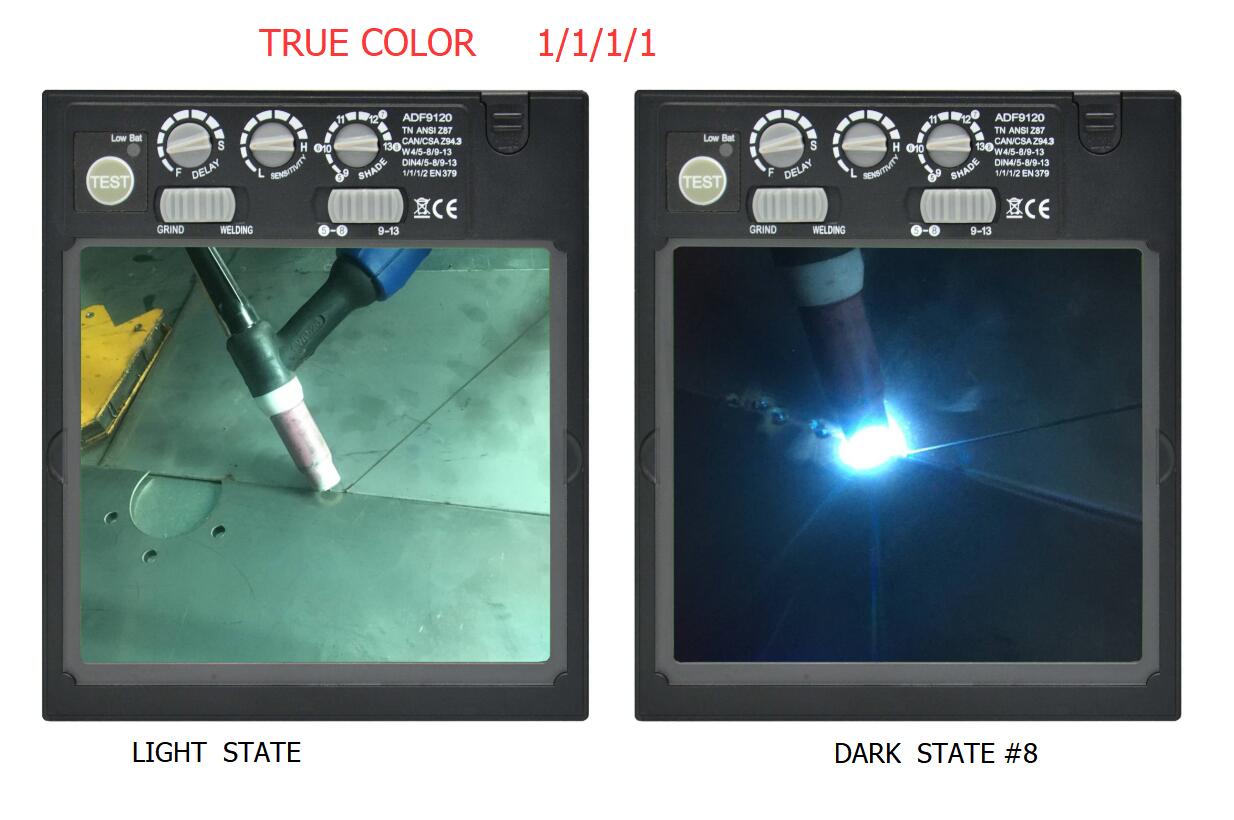
1.Ultra-Transient Response Architecture
The ADF9100 series features a full-field photosensitive array with a darkening speed of 1/25,000 second (light→dark) – 300% faster than traditional sensor-probe helmets. This ensures precise detection of 5A TIG welding arcs.
2.Extreme Environment Adaptability
Liquid crystal cells operate across -10°C to +55°C with IP65 protection, engineered for shipbuilding and polar pipeline welding in harsh conditions.
3.Dual-Mode Energy System
Solar cells and replaceable lithium batteries deliver 50,00+ operating hours, reducing equipment replacement costs by 60%.
Global Validation: From Workshop to International Standards
TynoWeld products have achieved ANSI Z87.1 (US) and CE (EU) certifications, with technical specifications surpassing China’s GB/T 3609-94 standard. The ADF series helmets are exported to 32 countries, deployed at premium facilities including:
- Rheinmetall welding workshops (Germany)
- Mitsubishi Heavy Industries production lines (Japan)
AWS 2024 Report findings: Welders using 1/1/1/1 helmets experience 76% reduction in eye fatigue and 22% higher first-pass weld qualification rates.
Dual Empowerment: Economy & Safety

Health Cost Restructuring
DIN 16 UV/IR blocking (vs. ≤DIN 12 in standard helmets) reduces arc eye risk to near-zero, saving large shipyards over $1 million annually in occupational health costs.
Efficiency Revolution
External control buttons enable parameter adjustments without helmet removal, reducing adjustment time by 25% and adding 1.5 productive hours daily.
Green Manufacturing
SMD eco-components and automated SMT processes cut carbon footprint by 40%, aligning with EU PPE sustainability mandates.
Future Roadmap: Gateway to Smart Welding Ecosystem
TynoWeld is expanding its 1/1/1/1 optical platform into IIoT nodes:
- AR Assistance: Next-gen NX series to integrate HUD projection of weld paths and thermal stress maps
- Data Interconnectivity: Bluetooth-synced welding current/gas flow parameters enable closed-loop process optimization
- Global Service Network: 48-hour technical response via Hangzhou HQ and NA/Eastern Europe centers
When a welder gazes into the molten pool, “1/1/1/1″ transcends four cold digits – it’s the optical shield forged by TynoWeld over a decade, silently bridging the gap between human physiological limits and machine response speeds. As global industry advances toward precision manufacturing, this optical revolution is redefining the gold standard of welding safety: True protection means eliminating hazards before they materialize.
Post time: Aug-13-2025